Search This Blog

Thursday, July 2, 2020

Quarantine Day #124

My quarantine began March 1, but some aspects go back even further. I fell September 2 last year, and  fractured my right tibia and bruised both legs thoroughly from ankle to knee (I have pictures, but I'm pretty sure you don't want to see them). I hobbled around for a couple of months and finally was unable to walk at all in early November. I've been using a wheel chair ever since. So, my world became very much smaller and closely resembled what I am now experiencing in quarantine.
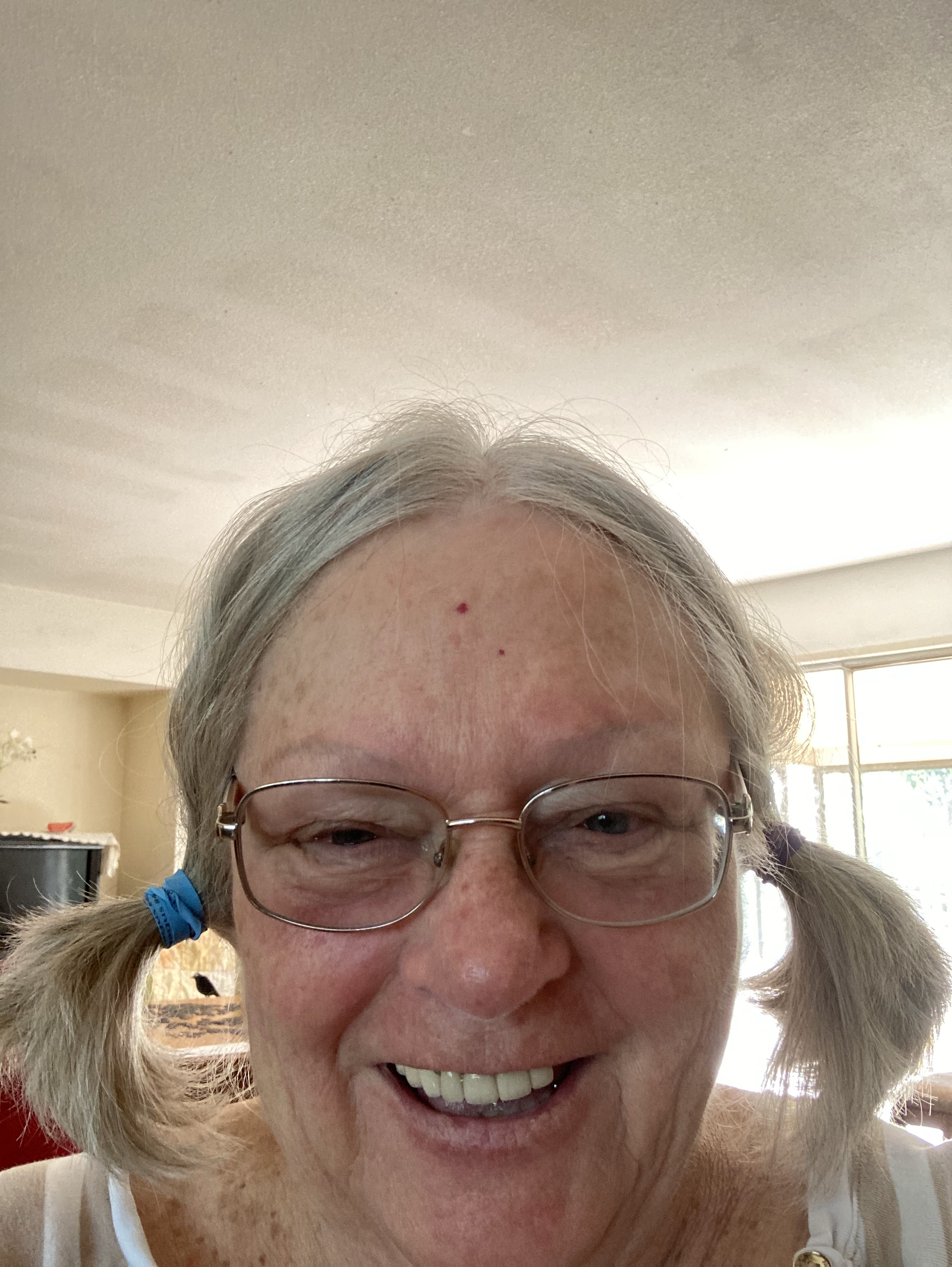
I don't know the date of my last haircut, probably sometime in October. Hair hanging in my face drives me crazy, so I've adopted a Pipi Longstocking coiffure. What you don't see in the picture is the mullet formed by the hairs that refused to be bunched up. Pretty goofy, but it's become my go-to daily hair style.

February 16 was the day I last set foot in a restaurant. Sister Valery and I had lunch with brother Rick -- the first time I had seen him since he and wife Kathy split up. And shopping at Trader Joe's sometime before the first of March, was the last time I set foot in a grocery store.
I now do all my shopping online, using e-cart for groceries and Amazon for just about everything else. Ben picks up the groceries and my prescriptions from CVS. But it really doesn't feel much different and I don't feel like I'm suffering. I've visited with a few friends and family members sitting outside, maintaining social distance and using masks as appropriate. No shared food. On a few occasions people have come into my home briefly. Upon their departure, I run around with Clorox wipes and Lysol spray.
All that said, I am not suffering, I don't feel deprived. My (inadequate) income continues. And like always, I sew, read, cook, write, and pay rapt attention to politics and social movements.
Here's my mask inventory for sale: all are adult size, have nose wires, and soft elastic bands that fit over the ear. I'm going to work on some smaller sizes and a couple of different styles in the near future. I have several of each of those in the bottom picture. The top ones are one of a kind at the moment, but I have more of the same fabrics and will be making more.


Wednesday, July 1, 2020

Back to the Blogosphere

I quit blogging when I felt what I had to say might hurt others. Time has thickened my hide, I hope my readers feel the same. I am compelled to speak out on so many things ranging from a very personal level to global issues. Maybe I'll step on a few toes, I'm okay with that. Folks are free to disagree in comments. I will publish any well-thought out opinions, but won't tolerate personal attacks directed at me (politicians are fair game), just leave out any nasty language, be creative, exercise your vocabulary. So you are going to hear about whatever is running around the squirrel cage of my mind.
Today it's masks. I'm for them. And I make them. And I hope to sell them.
They're $5 each, $1 shipping and handling. Each mask is made by me in my smoke-free, pet-free home from new material which has been laundered to remove any chemical residue from manufacturing. To order, email me at: melodyblairmoore@gmail.com, put "Masks" in the subject line. Please and thank you. I will evenually open an etsy shop, but I'm giving my friends a head start.


My beautiful model is Alexandra, daughter of beloved friend, Lisa. Every mask is made with love and prayers, hope, and good wishes for the wearer's good health from the heart and gnarled hands of this 81 year old woman. Custom orders can specify custom prayers! I'll show new masks at the bottom of each post.
In future posts I'll ramble on about politics, the pandemic, the opioid epidemic, the gun violence epidemic, racism, the declining global reputation of the USA, aging, books and maybe an occasional Netflix or Amazon Prime offering, food, travel, quilts, masks, family and friends, maybe a tad about the weather, but I'll try not to be boring.
Please tell your friends to follow me!

Wednesday, August 1, 2018

Seward's Folly-- Part III


Widowhood did not become my mother. She had gone straight from her girlhood home to marriage and motherhood. She often spoke of her loneliness as an only child and vowed she would not inflict that loneliness on her children. Remembering the large family of one of her friends, she said every night was like a party at their house, something she strove to emulate with her own brood. But, once everyone had left home, the only party she attended was her private party with Jim Beam. 

After the death of my father, she tried desperately to hang on to the traditions she had so carefully developed while raising her family, but unfortunately, alcohol clouded her ability to pull it off. I remember one particular evening. She prepared a huge elaborate paella, made from pounds of expensive fresh seafood. She invited several family members and a couple who had been friends from the UC Berkeley days. When dinner time arrived, she brought the masterpiece to the table stone cold. She had forgotten to cook it.

My mother's friend pulled me aside and said, "Poor thing, you children have got to do something about her."

She was drinking heavily, I found cash register receipts from several different liquor stores listing all kinds of booze: bourbon, scotch, vodka, gin, rum, etc. She deluded herself into believing she needed to stock up for a party or to have a full bar available in case someone dropped in for a drink. I looked at her cancelled checks. Some days she was so shaky so could hardly write. We did have to do something.

We planned an intervention. We tricked her into coming to a facility in Half Moon Bay where we gathered in a room. In a meeting facilitated by a staff member, we told her how concerned we were for her, how we loved her, and wanted her to be the person we remembered, the one who was bright, funny, creative, and sober. She was outraged. Even though she had already been drinking that morning, she denied she needed help, and asserted that she could take care of herself. She made it clear we were trespassing in her private world.

The therapist said she had never seen such a strong-willed resistant person and after a couple of hours, we declared the intervention a failure and took her home.

No further parties occurred. I took over holiday dinners except for one Thanksgiving; we decided to have dinner at the Claremont Hotel in the Berkeley hills. When I stopped by to pick her up, she was in a bathrobe and nowhere near ready to go. I explained she needed to hurry as we had to stop and pick up her father (Bobo) on the way to dinner. She disappeared into her bedroom for a long time and when I went to check on her, she was still in her robe, shuffling through stuff in her room, but making no move to get ready. She was in a blackout, unaware I was there and that it was time to leave. When I tried to explain that we were late picking up Bobo, she just laughed and said, "Oh, Bobo doesn't care." I told her I was leaving in ten minutes with or without her. Ten minutes later, while she was still in her bathrobe, I left.

I did pick up Bobo and, although we were late, joined ten other family members gathered for dinner. About half way through dinner, an apparition appeared at the entrance to our small dining alcove, and it snarled at me, "Melody, how dare you! I will never forgive you." Fortunately, she had taken a cab, and not driven.

I think of my mother in paradoxical patterns; she was shy and introverted, thought of herself as a "private person", but she loved parties. She worked faithfully to make holidays and birthdays special to each of us. And I think she loved the release of inhibition from the alcohol that flowed freely on those occasions. Sadly, as she drank alone, she became reclusive and shut herself off from friends and family. She lived alone and in filth with a little dog who never went outside. Her one constant contact with the outside world was a phone call she made each morning to her father, to make sure he had made it safely through the night.

One morning, he called me to say he had not heard from her. Her telephone went unanswered. We both knew this was an ominous sign. I lived an hour away, in San Jose, but decided to leave right away to check on her. I hung up the phone, and called my son-in-law, Wes, arranging to pick him up to make the trip to Oakland with me.

Arriving in her driveway, we kicked our way through piles of fallen leaves to the locked front door. Looking under all the obvious places, empty flower pots and planters, decorative rocks and ceramic frogs, we found no key. Breaking a window in the still unfinished downstairs game room, Wes worked his way upstairs through trash, dirty clothes, and dog feces littering the green shag carpet, to open the front door. We made our way through the silent house to her bedroom while the dog, a filthy shaggy toy poodle, sniffed at our heels. She lay on a mattress that was askew, half off and half on the bed, her head seemed caught between the mattress and the headboard. She responded to her name with a groan, and we managed to get her to an upright sitting position. She seemed conscious, but unaware of her surroundings and with no sense of who we were, why we were there, what had happened, or anything else that would affirm that she was mentally present, so while I sat with her, Wes called 911.

She was admitted to the hospital and diagnosed with a brain bleed of unknown cause.
Comatose for several days, the initial outlook was grim. She was not expected to be able walk, talk, or participate in her own care. But, she did regain enough function to be able to live in assisted living for a number of years, an arrangement that brought her safety and was a relief to all of us who cared about her.

I assumed Power of Attorney and rented out Seward’s Folly. The rent money, along with her other sources of income, provided for her very comfortably the rest of her life. When she died, the mortgage-free house was sold, and each of the heirs received a nice little sum for indulging their own follies.

Thursday, October 22, 2015

Seward's Folly -- Part II

We dreamed of a large, comfortable house with a bedroom for each kid and spacious common areas to serve for family gatherings and parties. The reality was an all-consuming monster that ate our family.

The first few years were filled with dreams, plans, foundations, and hope. Then, years passed, and little progress was made on the new house, while the old house continued to deteriorate, as did our family.

My mother slowly settled into drinking more and doing less. From time to time, she seemed to bob to the surface and show some signs of life, learning to drive, taking Spanish lessons, joining a garden club, or leading a Bluebird troop for my sister, Valery. But, for the most part she became more reclusive, spending hours in her rocking chair, smoking cigarettes, working crossword puzzles, or playing solitaire, sipping on bourbon and soda, and taking long naps.

She had a set of household tasks she performed religiously. She always made her bed when she got up in the morning, started the coffee, and prepared breakfast for the kids. Each morning she made sure her kids went off to school with a hot breakfast in their tummies, and a  brown paper lunch bag filled with a sandwich, homemade cookies, a piece of fruit, and a paper napkin.

Every night, we ate dinner together in the dining room. Rarely, was anyone missing, and it was just as unusual to have a guest. The table was carefully set for seven people; dinner plates, salad plates, paper napkins, and silverware were laid out in Emily Post-perfect order. The silverware was sterling and we always used salad forks as well as dinner forks. Our mother brought the food to the table in serving dishes which were passed around, so we could each serve ourselves. Ritual was infused in our meal practices, but not until recently did I view them as offerings of love by our mother who was not able to demonstrate love in ways more easily understood by children.

I set the table until Valery was old enough to take over. Then, I was promoted to salad maker. Those were the only two chores that were ever assigned in our household. No one but our mother ever did the dishes. I never understood that, but she didn't want us doing them. And, of course, this was before every kitchen had an automatic dishwasher. We never ate out during those years before frozen meals and takeout. And I don't remember my mother ever being ill or missing a meal, except when she went to the hospital to have a baby.

She seemed almost possessive about meal preparation and dishwashing, unwilling to let the kids do any of it. Laundry was the same. In 1953, we got a brand new automatic Westinghouse front loading washer and a dryer that played the tune to "How Dry I Am" at the end of the cycle. They were installed against the far wall of the back room, their bubble glass doors looking across the room like a gigantic pair of eyes.The washer and dryer were in constant use, but nothing ever got ironed or put away. A mountain of clean clothes was piled on a nearby table. We pulled what we needed out of the pile and ironed it ourselves, if necessary.

The back room was an unfinished room, about 20 feet square, attached to the house by a breezeway. It served as my father's office as well as laundry room. It also had a toilet, but not a full bathroom. His drawing table was positioned under a north-facing window; it couldn't have been for the light, I don't believe that grimy window was washed once in the twenty years I knew of.

The back room was the repository for his not-so secret bottle of wine. He never left the house without a stop in the backroom, ostensibly to use the toilet, but he always left the room drawing the back of his right hand across his mouth and and emitting a breathy mahhhh sound. His left hand would reach into the front pocket of his trousers and withdraw a tube of lifesavers. Removing one peppermint circle from the tube, he would blow tobacco shreds from the center of it before popping it into his mouth. Then he was ready to hit the road.

 I left home to begin married life in 1959 and my brother Mickey joined the Air Force a couple of years later. Neither of us would return to the family home. So, instead of five, there were now three chicks left in the nest.

The house progressed slowly. Beautiful blue-green granite stones were purchased for the large fireplace in the family room and slate for the floor of the entry way. Framing and roof joists began to give the structure a three-dimensional aspect. The fireplaces were installed and the chimneys rose through the roof line. And I remember joining in the family prayer for a dry October as preparations were made for the installation of the roof, a large flat surface of crushed white marble. Windows and siding were added and the house was enclosed.
My father in his weekend uniform, wifebeater shirt and baggy khaki pants, 

Christmas, 1968, still in the old house,

By Christmas 1968,  the oldest two of the Blair children, brother Mickey and I, had produced five members of a new generation. They gathered under the Christmas tree, which was, as usual, placed in front of the door to nowhere. At that time, brother Ken was a sophomore at UC Berkeley, and Valery was finishing high school. Mickey, Ricky, and I were all married and living in our own homes. The marriage and the very lives of my parents were on unstable ground, The new house was at a standstill and all resources of cash and internal fortitude had been tapped out. 

My mother complained to me on the telephone that my father never did anything but pace around the unfinished interior of the new house and that she was going crazy living in the tumble-down old house. And, in fact, I believe she was going crazy. At one point, she disappeared for several days and no one knew where she was. She had taken their beloved German Shepherd, Jody, with her, so my father felt reasonably sure she was not suicidal. She loved the dog so much, he felt she would not take the adored animal into a dangerous situation. In retrospect, I believe she was suicidal, but I was so wrapped up in my own life, I took what my father told me at face value and didn't doubt him. She was drinking very heavily on a daily basis and when she was alert, she raged at her youngest daughter, Valery. 

My father complained that he didn't know what to do with my mother. Her drinking was going to be the ruin of him and he just couldn't stand it anymore. I was helpless, caught in the middle, and suggested to each of them that they leave the other. Each reacted the same way, as though I had blasphemed, "I could never leave your mother/father! How dare you even suggest it!"

A last draw on his inheritance, and probably more refinancing, produced a final infusion of cash. At last, in 1971, after all five children had left home, eighteen years after moving into temporary quarters in the tumbledown Victorian, my mother and father moved into the dream/nightmare house. It wasn't entirely finished, bricks still lay in piles around their ultimate destination as a decorative element on the exterior of the lower story. The downstairs pool room and workshop walls were unfinished, and parts of the exterior lacked paint, but a certificate of occupancy was issued, and the old house was emptied and demolished.
Demolition of the old house. The kitchen sink is to the left, my bedroom to the right. The only bathroom, with a tub and no shower, was in between the kitchen and my bedroom.


Preparing to topple the chimney of the old house

The house was torn down, all but the back room, left standing and visible in the picture above, with my father standing in front of it. It still held his drawing table, building material catalogs, architecture textbooks, drafting tools, probably the bug-eyed washer and dryer, a supply of empty wine bottles, and in all likelihood, some unfolded laundry.
My daughter, Colleen standing on the felled chimney, you can look across the debris field to the new house.
Six grandchildren and the first Christmas in the new house, 1971

Just as construction was being completed, my mother's mother (Mimi) died, leaving  a bunch of cash and telephone company stock which was promptly liquidated to provide funds for furnishings. My mother entered a gloriously productive sober period and went into a decorating frenzy. She attended a class on interior decorating, sewed curtains, bought and arranged furniture. The youngest two children, Kenny and Valery, were at that fledgling state in their lives where they bobbed in and out of the nest for a brief while. But, for the most part, the nest was empty and my mother and father had the roost to themselves.

In 1973, my father's mother died and he collected the remnants of his inheritance. For the first time in twenty years, it wasn't necessary to pour all available time and money into the new house. My parents used the money to travel the world. They made friends in the UC Berkeley alumni association, and they entertained. I think the years from 1973 to 1984 may have been the happiest in their lives. The kids were all grown and independent, the soul-eating behemoth was placated, and they were free, free at last.

Of course, the story doesn't end there. My father died on April 1, 1984 of a sudden heart attack after a night of smoking, drinking, and dancing. He was 71 years old, and my mother was a widow at 65. For the first time in her life she was entirely alone.

Tuesday, September 8, 2015

And Then There Were Five


On October 18, 1949, Kenneth Lee Blair was born and I was ten and a half years old. I remember answering the phone (a heavy black bakelite phone with a rotary dial and a springy cloth-covered cord), when my mother called from the hospital to announce, "It's a boy!" and I remember being very disappointed I didn't get the baby sister I wished for. But, I rebounded as soon as I held my sweet new sibling in my arms. I felt as though he was my own real live baby doll. I kissed him and cuddled him, dressed him, took him for walks,and thought he was the cutest, most perfect being on the planet. Changing his diapers and feeding him were duties my mother gladly yielded to me and I considered them a privilege.

I remember pushing him in his Taylor Tot down to the new Lucky's Supermarket where an old lady stopped us to fuss over the baby. She looked up at me and asked, "Is he yours?" 

Her question filled me with pride, but I told her the truth, "No," I said, "How old do you think I am?"

She replied, "Oh, I don't know, they have them so young these days." I wished he were my baby and maybe in a way, he was. I had a maternalistic bond with Ken that endures to this day, even though he died in 1993 and I felt the loss as deeply as the loss of a child. 

The picture below was taken in April of the last year we lived in the Athol Avenue house. That July, when my mother was five months pregnant with her fifth child, we moved to 5501 Leona Street, to a tumble-down Victorian era farmhouse on an acre of land in the Oakland Hills. My parents had visions of living in that house only as long as construction of their dream house was under way. But, that's a story for another day.

Easter 1952

In 1952, my mother finally delivered the baby sister I waited for so long. Valery Joan Blair was born October 25 and again I remember answering the phone call from the hospital. "It's a girl!" announced my mother.

"I knew you could do it!" was my response. 

And like for brother Ken, I had lots of opportunity to practice my child care techniques. From the time I was five years old and told to keep an eye on Mickey, until I left home, I always had a hand in caring for my younger siblings.

With Mickey, I felt an intense sense of displacement and sibling rivalry. I didn't have the same issues with my second brother. When Ricky was born, I was nearly five. My job was to keep Mickey safe and out of the way while our mother took care of Ricky. Ricky had a few health struggles when he was young: asthma and a milk allergy as an infant, and a severe case of whooping cough when he was about five. I was too young to be directly involved in his care, but I felt he was very special and needed to be protected.

Because I was involved in the hands-on care of both Kenny and Valery, I felt very maternalistic toward them. At the same time, they grew to be very close to each other with frequent escapes into a fantasy world created by the beautiful and creative mind of Ken. 

As they grew closer, I grew more distant, moving into my own world filled with girlfriends, boyfriends, and plans for a future formed by my past.


Christmas, 1954

Monday, August 10, 2015

In Sickness and in Health

These are real events as I recall them. After August 20, 2015, when Logan goes off to college, I will again veer off into my fantasy road trip.

Much of my adult life I've been harshly critical of my mother because of her alcoholism. I'm sad and angry that it removed her from active participation as a grandmother in the lives of my children. Today I put that aside and remember the selfless, tireless, beautiful young mother I had as a child.
She was  just twenty when I was born, two years after her high school graduation from Oakland High School in 1937. She and a group of her girlfriends had formed a sorority they called the Maddi Kappi; they hung out together and met a bunch of architectural students from Cal (UC Berkeley) and that's how I came to be.

She was a student at Heald's Business College, but she didn't finish the program. She worked one Christmas season wrapping gifts at Hale's Department Store in Oakland, the only job she ever held. According to Social Security, her lifetime earnings were just over $200. And then, she became a mom.

I always thought she looked kind of like Lauren Bacall. She was fun, flirty, loved to dance, and loved to sing, always humming under her breath as she went about the housework. I was proud of the way my young mother looked and felt sorry for the kids with fat frumpy older moms.

My father was a student when my parents married and he worked part time for Standard Oil as a draftsman. He graduated from Cal a year after I was born. Shortly thereafter, he went to work for Owens-Illinois as a draftsman and then later as an architectural engineer. He remained in that position until his retirement. His salary was always just a little short of what we needed to get by, so he supplemented it by spending hours at the drafting table he set up in our dining room, drawing house plans for all the executives at the glass factory. He designed several homes which are still standing in Piedmont, the Montclair district, Orinda, and Oakland. He further supplemented his income with a series of loans from his mother, drawing down on any future inheritance.

In those days, the only inoculations available for kids were DPT and they weren't mandatory, so we didn't get them. These were also the days before health insurance, so any doctor's visit was an unplanned expense and our household had no room in the budget for unplanned expenses. Only maternity care was allowed in our household. 

I don't remember my mother ever being sick, or even slowed down by her pregnancies -- five of them (although today I'm writing about a time before the youngest two were born). I have vivid memories of the times we were sick and the wonderful loving care she bestowed on us.

Measles, we called them the red measles, the two-week kind, were epidemic among kids from about five to eight years old. And we caught them serially, so for six weeks a fevered child lay in my mother's bed. The shades were drawn because of the risk of eye damage, I don't know if darkness really did anything to prevent damage, but we also weren't allowed to read for the same reason. I remember running a fever of 105 degrees and my mother getting almost. but not quite, worried enough to call the doctor. In lieu of a doctor's house call, my father called Dr. Bensinger, the plant doctor. He became our de facto family physician.

When we were sick we slept in our beds by night, but in the daytime, we rested in our parents downstairs bed and we were treated royally. Mom read to us, sang to us, brought meals in on a tray, and bought treats like comic books or ice cream bars. When she left to walk down to the corner store, we got out from under the covers and jumped on the bed. Being sick had lots of perks. 

In addition to the measles, chickenpox and mumps won us time in our mother's bed. For some reason, we never caught rubella, known to us as the German measles, the black measles or the three-day measles.

Brother Rick (the little guy in the pictures), and I had the whooping cough. I had what was probably the world's lightest case, I barely coughed with a slight whoop for six weeks and felt fine most of the time, but I had to stay out of school. They said whooping cough was two weeks coming, two weeks there, and two weeks leaving, comprising the six week quarantine period. Rick had a terrible case. Every time he coughed, he vomited. He coughed until the blood vessels in his eyes broke. He became very thin and we were all very worried about him. He was given special drinks to keep him hydrated and fed lots of Popsicles. I think Popsicles were a universal cure, at least in our household. 

But the worst, the very worst, was the ringworm. My father had taken in a stray kitten. We loved it and cuddled it and fought over who would get to hold it next. And then I began to itch on my chest, right where I snuggled the kitten. Soon both my brothers were itching in the same spot. This time my parents took us to the doctor. The first diagnosis was impetigo. When we returned to the doctor in even worse shape with the condition spreading to our arms and legs, the diagnosis became scabies. Finally when the eruptions settled into the characteristic round shape of ringworm, the accurate diagnosis was made, and the kitten was identified as the source of our malady. Sadly, by that time our other household pets, my beloved cat, Dingle, and our sweet cocker spaniel, Duchess, had to be put down. 

Not only did we lose our household pets, but all our stuffed animals were burned. By this time our entire bodies were covered including the scalps of my brothers. Their heads were shaved, but my scalp was spared and I had to wear my hair tightly braided and pinned to the top of my head. Ours were the worst cases of ringworm the doctor had ever seen. He referred us to the dermatology clinic at the University of California Medical School. There, a half dozen dermatologists peered at us and photographed us for medical journals. 

The outbreak began in June just as school was letting out for the summer. The treatment called for rigorous cleanliness and isolation from any other kids. Our parents were absolute saints during this time. I'm sure they felt enormous guilt for bringing this plague into the house, but the effort they put forth in caring for us and entertaining us was superhuman.

 Like every household in 1949, we had only a wringer washer, Our mother washed and line-dried our bed sheets every day. We bathed morning and night and had a salve called Salinadol smeared over all our lesions. My hair was shampooed daily, greased with the gooey salve, braided, and pinned up out of contact with the eruptions on my neck and forehead. Gallons of Hexol were used in cleaning every surface of the house. My mother worked to keep the bugs at bay from dawn till she fell in bed at night.

The picture below was taken two months before ringworm turned our beautiful skin into a repulsive mass of sores. It sat on my mother's dresser where she would look at it and weep, wondering if her children would ever be beautiful again.
Our parents went to great lengths to entertain us and compensate for our cloistered summer. My father built wonderful toys, using cardboard and wood liberated from the stock piles of the glass factory. He built a 5/8 scale stage coach with doors that opened and shut, seats inside, a seat outside for the driver and a side kick. Horses heads also made from cardboard fit over our heads and rested on our shoulders. My grandfather (Bobo) gave us a regular full-sized pinball machine that we operated using slugs instead of coins. Both the stage coach and pin ball machine were in a garage we used as a rumpus room. Mimi bought us books; we couldn't contaminate library books. We had homemade stilts and a constant supply of new comic books.

Our mother sang to us and our father told us stories. He made up a stories about the Whiffenpoofs, a family who had ringworm, but were able to put them to good use. They would scrape them off and use them as tires on their cars and take wonderful trips. And we did take wonderful day trips. We explored the entire bay area, took the ferry to San Francisco, or had picnics in many of the wonderful East Bay Regional Parks, and went for walks in the woods.

By the time summer was over and school was ready to start, we were cured. We didn't miss a day of school and our exhausted mother had a chance to rest.

Sunday, August 9, 2015

School Days

Another installment of reminiscing prompted by my trip to Oakland. These too, are true so far as memory allows.  

I started kindergarten at Cleveland School in January 1944. At that time, kids could start mid-year because of a semester system that divided each grade into "high" and "low." I think it is a good system; a child who wasn't quite ready for school in September could start in January and not have to wait a whole year to begin. And my mother loved it. She still had two more little kids at home; the nest was getting a little crowded.

I was a mid-year kid until I skipped the high third grade, going directly from low third to low fourth grade. My mother cautioned me, "Don't go thinking it's because you're so smart, it's just because your class was too crowded." But I was immediately placed in the top groups in reading and arithmetic (we didn't call it math until the fifth grade).


The desks we sat at like those in the picture were mounted on wooden runners. I remember running the edge of the sole of my shoe along the runners and along the grooves in the pine floors. The smell of the oiled floors mixed with that of chalk dust and the ink in our ink wells created a particular school room perfume which is lodged in olfactory memory. Third grade had a special rite of passage. When we had satisfied Mrs. McNary we had mastered the Palmer method of cursive handwriting, we were issued pens and blotters and our inkwells would be filled. We dipped our pens in the blue-black liquid and carefully scratched out the final copies of our compositions. 

Mrs. McNary's classroom was in one of the portables. Being assigned to a portable was a special honor because they were heated by coal-burning stoves. Not only did we have blackboard monitors, but some lucky boy was also chosen for the highly esteemed position of coal monitor, charged with keeping the coal bucket filled, and stoking the fire as needed. Girls could be blackboard monitors, but only boys were allowed to be coal monitors.

When I was in about fifth grade, a boy just a grade behind me died by hanging in the basement of his home. We were told it was an accident and I never doubted it. Even though these were the years polio was rampant, and several friends had been crippled, it had never occurred to me that a child could die. Another tragic event was the murder of the mother of a classmate. His brother had bludgeoned their mother with a hatchet in a ferocious rage in the basement of their home. My classmate continued at school, but I could never bring myself to talk to him after that. Even looking at him was difficult and made me wonder if my brother were capable of such a thing. I couldn't bear the possibility of losing my mother. And I feared tragedy was contagious. 

Clayton Wright was my first boyfriend. One day our fifth-grade substitute teacher caught us passing love notes in class. She called both of us to the front of the classroom and while holding me in a hammerlock, squished against her ample bosom, she forced me to read the note aloud to the class. I'm not sure why it bothered me so much, everyone had opened and read the note as it made its way across the classroom, there was no secret within. But I still remember the mortification and the smell of that woman: a mixture of Vick's Vap-O-Rub and gardenia perfume. However, my love for Clayton was undiminished by public shaming. 

Clayton gave me a chocolate-covered marshmallow heart for Valentine's Day. The tinfoil wrapping was all wrinkled because he had unwrapped it to enclose two dimes so I could meet him for the Saturday matinee at the Parkway theater.

I was more excited about having two dimes than the prospect of going to the movies with Clayton, so I rounded up a couple of girlfriends and we headed for the school store. The school store, located just behind the school on Brooklyn Avenue was in the downstairs corner of the house pictured below with an entry right on the corner. Inside, was a fabulous assortment of penny candy, Mary Janes, sugar dots on paper, wax lips, wax bottles of sweet syrup, several kinds of licorice, lollipops, and both Fleers and Bazooka bubble gum. I bought a little of everything and shared it with my friends. Fortunately, I was able to beg 20 cents from my father to keep my date with Clayton, In fact, the entire fifth grade class kept our date. They sat in a solid line in the row behind us. I was so annoyed that I got up and moved to a seat by myself. As near as I can recall, that was our last date.


The map above illustrated the approximate boundaries of our free-range territory. It is about a three-mile square area, with Lake Merritt as its main attraction. The red X marks the location of our house. I know as young as nine years old, I borrowed a friend's bicycle and rode all around Lake Merritt, a distance of 3-1/4 miles. My mother never knew about it. When I was ten, I got a beautiful Schwinn bicycle for my birthday and frequently rode around the lake. So long as we appeared for meals, we never accounted for our whereabouts.


The year I was in fifth grade, I got a violin for Christmas. It was a wretched piece of equipment; the tuning pegs would never hold, and it was constantly slipping out of tune. The fact that I was a terrible musician compounded the horror. Even worse, I loved playing the violin and practiced relentlessly while my mother would beg me to please, please, please, use the mute. You can probably tell by my awkward pose that I simply had no feel for the instrument. 

In the picture of the three little musicians, you can barely make out built-in cabinets on either side of the fake fireplace. The one on the left housed my Story Book Doll collection. Although I never played with dolls, I loved getting new Story Book Dolls to add to my collection every birthday and Christmas. My parents, grandmother (Mimi), and Aunt Helen all helped my collection grow until I had around thirty dolls. When I grew a bit older, they were boxed up and stored in my closet. I noticed one day they were missing and later learned my brother had given them away to his girlfriend. My parents did nothing to help me get them back and he was never held accountable for taking them. I've worked really hard over the years to let go of resentment toward my brother, but this one surfaces from time to time and I'm still mad.